
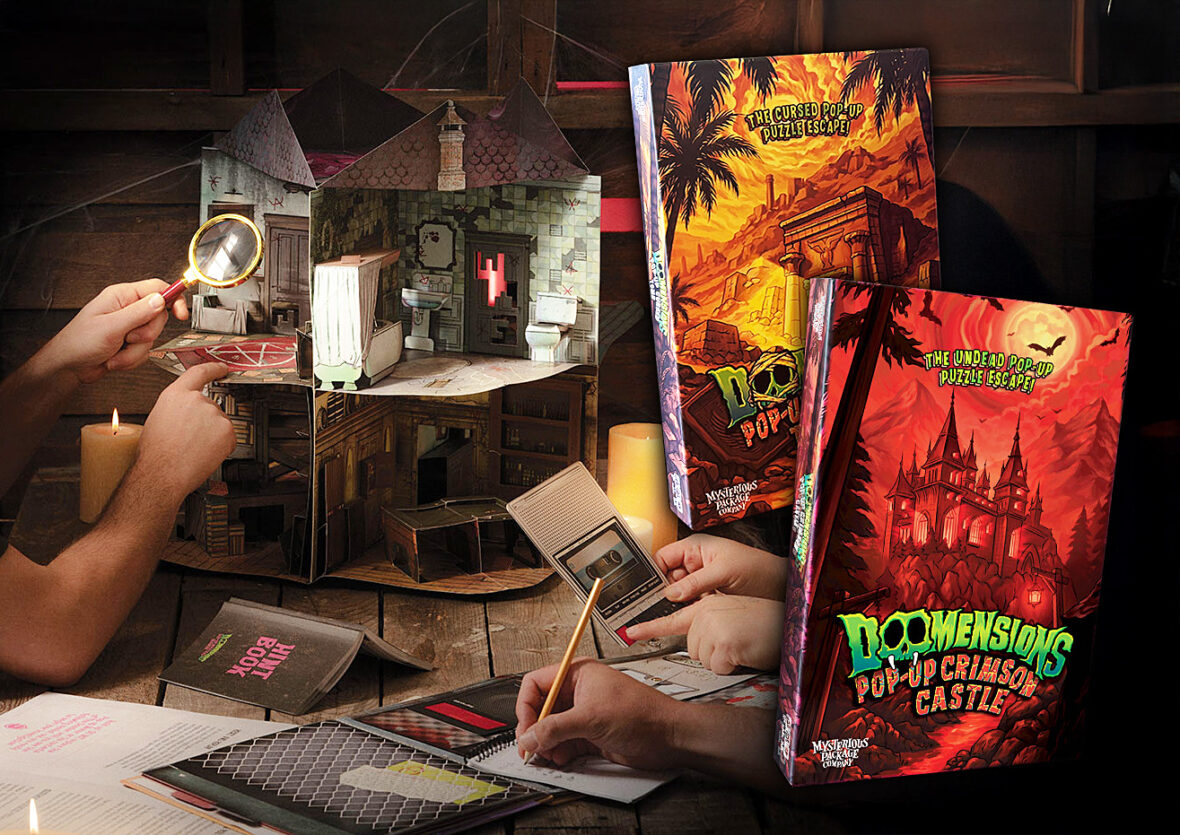
In 2022, the Mysterious Package Company ushered in a new era of puzzle games with “Doomensions”: a pop-up house packed with secrets, puzzles and wild paper mechanisms. “Crimson Castle” and “Cursed Tomb” have now launched on Kickstarter, bringing us two new adventures from the creative minds at the Canadian company. I asked the Mysterious Package Company how these games are made—and received answers from Creative Lead Mike Smith. [READ THIS ARTICLE IN GERMAN]
If there is one company whose games I have a particularly special connection with, it is the Mysterious Package Company. My journey into the world of English-language puzzle games began with this Canadian company during the pandemic—with “The Buried Puppet”, a game that, funnily enough, I still haven’t played to this day. But the way this adventure presented itself as soon as I opened it made me want to own even more titles from the English-speaking world. I wanted to discover more unusual puzzle games with fantastic props—and to be surprised again and again by what awaited me inside the boxes.

The Mysterious Package Company (MPC), which was founded back in 2013, has remained a constant companion of mine in the years since that first encounter. At first, I collected the company’s so-called “Crates”—wooden boxes filled with mysterious documents and deceptively realistic artefacts that tell stories, sometimes through puzzles as well. Later, I enjoyed every single game from “The Curious Correspondence Club”, a company founded by MPC employees in 2020. Across a series of 24 interconnected puzzle adventures, its creative minds pushed paper to its limits: in every instalment, the contents of the slim envelopes transformed into puzzle machines featuring mechanisms unlike anything you are likely to have seen before.
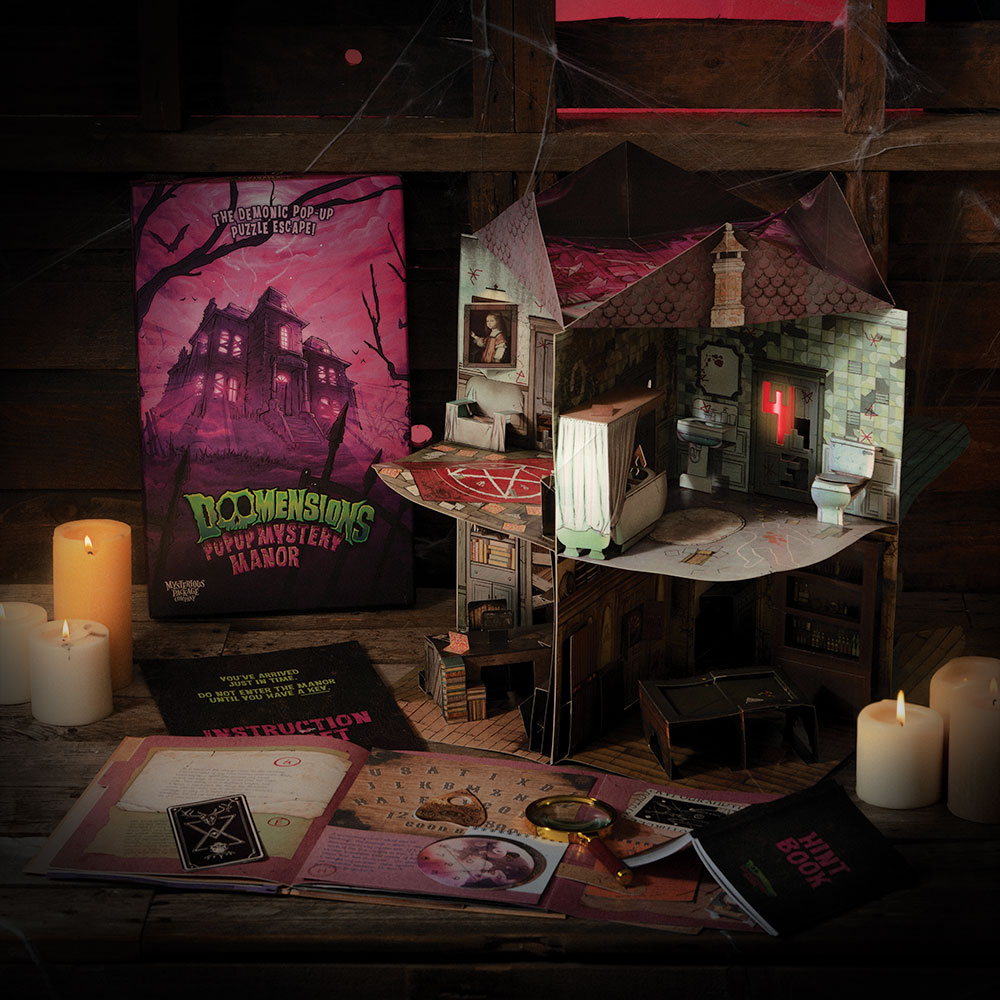
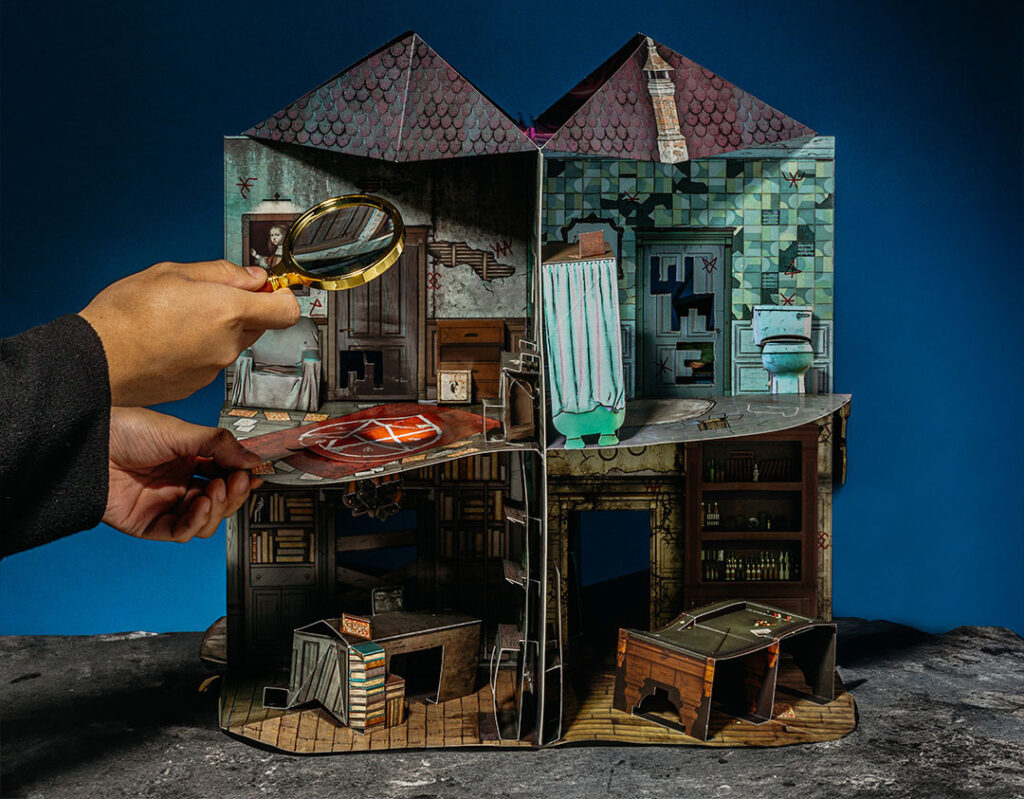
“Doomensions: Mystery Manor” was created in 2022
Since 2022, the Mysterious Package Company and The Curious Correspondence Club have been working together again. Among other things, this collaboration gave the gaming world “Doomensions: Mystery Manor”, a mad pop-up game in which a large and unbelievably beautiful haunted house unfolds across the table. You puzzle your way through the house using a wide variety of brilliantly designed objects and documents.
Here, the Mysterious Package Company’s world of extensive stories and realistic design is combined with the paper-engineering ingenuity of The Curious Correspondence Club. You can hardly imagine how excited I was to learn that the series would now continue with “Crimson Castle” and “Cursed Tomb”. The project is currently being funded through Kickstarter—and it was a tremendous honour to be able to ask MPC a few questions about the game.
While the return of “Doomensions” came as a surprise to me, the two new games have been in development for quite a while, reveals Mike Smith, Creative Lead at the Mysterious Package Company. “When we created the original Doomensions: Pop-Up Mystery Manor, we knew the format had the potential to go beyond a single game, but I don’t think we had a grand roadmap of exactly what a series would look like.” Above all, the players’ response to the new project convinced the team. “People loved that the environment wasn’t just a backdrop or something decorative — they were physically investigating it, turning it around, looking through windows, finding things hidden in rooms and gradually understanding how the whole structure worked.”
How the idea for “Crimson Castle” and “Cursed Tomb” came about
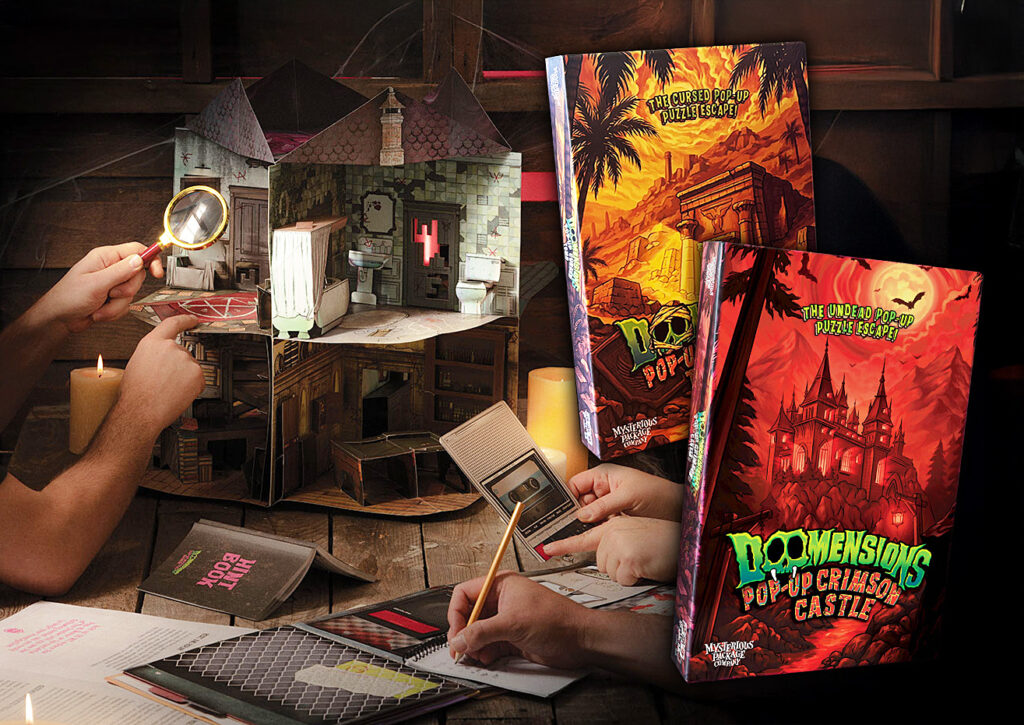
The team therefore began thinking about which other locations would be exciting to explore—and the ideas for “Cursed Tomb” and “Crimson Castle” gradually emerged. “Crimson Castle” tells a vampire story set in a decaying castle. Mike Smith says: “You’re investigating the history of the place, its inhabitants, and a rather unpleasant series of events connected to the figure at the centre of it all.”
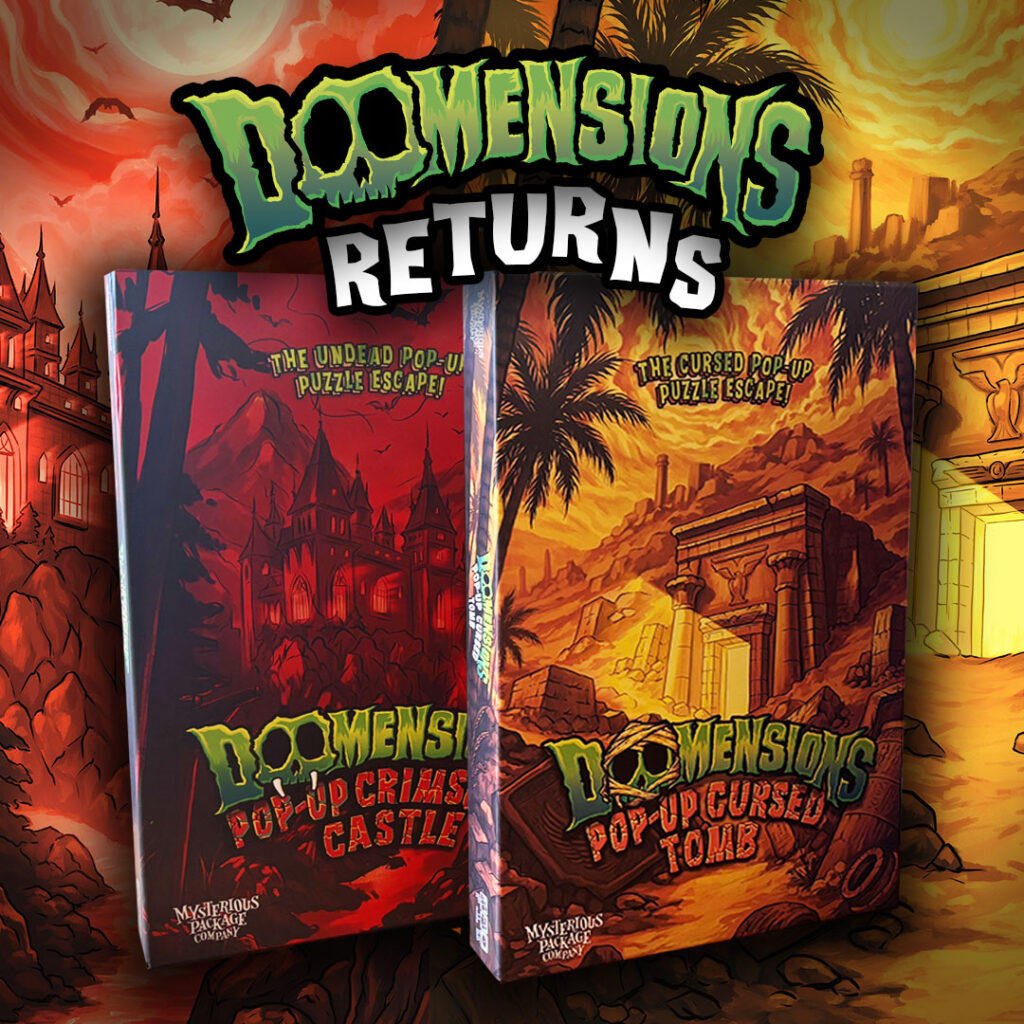
“It has crypts, chapels, graveyards, hidden passages and all the things you’d want a good vampire castle to have.” “Cursed Tomb”, by contrast, is the story of an Egyptian tomb where, according to Smith, something has gone badly wrong. “You’re piecing together what the team discovered, navigating the tomb itself, interpreting symbols and artefacts, and gradually uncovering what perhaps should have remained buried.”
The most fascinating element of the games is likely to be the pop-up mechanic. This time, there will be even more interaction with the in-game environments. Smith explains: “There are physical objects to manipulate, information that moves between the dossier and the structure, deduction puzzles, environmental puzzles and some surprises we would rather not spoil.”
Alongside a playing time of up to 12 hours per adventure, another notable feature is that no internet connection is required. The Creative Lead explains: “One of the things we love about Doomensions is that you can spread everything across a table and disappear into the world for an evening without the game becoming an app-driven experience.” The amount of time invested varies from group to group. Smith says: “We’ve had people work through the Mystery manor in one 8 hour session and others that broke it down into five separate sessions.”
How the “Doomensions” games are developed
The creators have also invested a great deal of time—because anyone who has ever unfolded “Mystery Manor” will immediately understand just how much thought must have gone into it. It is no surprise that development took quite a while. Once the team had found the right setting for “Doomensions”, the story, puzzles and mechanisms were developed in parallel. Simply designing a structure first and adding puzzles afterwards does not work with this concept. The Creative Lead explains: “A wall, doorway, staircase or piece of furniture might eventually become part of a mechanism, so the architecture and the gameplay have to grow together.”
Everything is tested using prototypes. Smith explains: “We build extremely rough versions, discover which ideas work and which absolutely do not, change puzzles, rebuild parts of the environment, test again, and gradually move toward something that resembles the finished game.” He continues: “Once the puzzle structure is working, we turn to illustration, graphic design, writing beautification and production design.”
And then, of course, everything is again tested extensively—with manufacturing also taken into consideration. “Something can be a wonderful idea in a handmade prototype and completely impractical when you have to manufacture thousands of them.” A prototype that has taken days or weeks of work can function with incredible precision. But the game also has to work when it comes off the factory production line.
Pop-up games like “Doomensions” are a challenge
With a pop-up game like this, the entire system is extremely sensitive to errors. In a conventional puzzle game, Smith explains, a puzzle can often simply be rewritten if it does not work. Not in “Doomensions”. “In a Doomensions game, that puzzle may depend on a printed illustration, which depends on a particular fold, which may already affect three other rooms. On top of that, its output is programmed into a wheel and is woven into a broader meta puzzle.”
If anything goes wrong, the chaos is complete. “Changing one thing can create a chain reaction throughout the entire experience.” Smith even noted in the written interview that he was taking deep breaths at this point. We can all imagine what that means.

On top of all that, everything has to be stable enough to travel safely from A to B by post, often across very long distances. Smith says: “These environments have to arrive fully assembled, survive international shipping, open correctly, remain stable on the table and withstand several hours of people enthusiastically investigating them.” Ideally, the players should never even notice all the work that makes this possible. “Ideally they simply feel that they’ve opened a mysterious place and started exploring it.”
What’s next for “Doomensions”
It remains to be seen exactly how the series will continue and which journeys of discovery through the world of paper the Mysterious Package Company will take players on next. For now, the focus is on producing “Crimson Castle” and “Cursed Tomb”. The Kickstarter campaign runs until October 22 and, with around 370,000 Canadian dollars raised so far (approximately 230,000 euros), is already a massive success. “Innsmouth Rising” is also currently in development, a new adventure presented in a wooden box and a journey back to the roots of the Mysterious Package Company.
But fans of the company can look forward to more. As Smith says: “We always have several strange things taking shape behind the scenes, although we’ve learned not to announce them too early.” Strange things? As someone who has played quite a few games from the developers’ workshop, I can say this much: strange is often an understatement.
All the details about
“Doomensions Returns”
Title: “Crimson Castle” & “Cursed Tomb”
Company: Mysterious Package Company, Canada
Format: Pop-up game with documents
Genre: Adventure
Campaign launch: September 22, 2026
Campaign ends: October 22, 2026
Funding goal: Around 40,000 Canadian dollars
Price of the base game: CAD 89 (around 55 euros) per title,
CAD 160 (around 100 euros) for both games
Estimated delivery: September 2027
More information at the Kickstarter Page